What Is the 7 Deadly Sins Test Quiz?
The 7 Deadly Sins test quiz translates a centuries-old moral framework—Pride, Envy, Wrath, Sloth, Greed, Gluttony, and Lust—into a modern self-reflection check-in. Rather than asking archaic theological questions, this online quiz looks at ordinary twenty-first-century habits: procrastinating until a deadline hits, comparing your timeline against social media highlights, refusing help when stuck, or struggling to stop scrolling once you are tired.
By translating each classical vice into concrete behavioral patterns, the 7 Deadly Sins test quiz helps you spot which everyday impulse most quietly steers your decisions—and which classical counter-virtue offers the clearest counterweight.
How Scoring Works in This 7 Deadly Sins Quiz
Transparency matters in any personality quiz. Here is the exact scoring math running inside your browser:
- 21 Interleaved Statements: Each of the seven traits is measured by three distinct everyday statements arranged in a mixed order so you can answer naturally without second-guessing categories.
- 5-Point Agreement Scale: Every answer maps to a clear numerical value: Strongly Disagree =
0, Disagree =1, Neutral =2, Agree =3, and Strongly Agree =4. - Independent Percentage Formula: Each trait has a maximum possible raw total of 12 points (3 questions × 4 points). Your percentage for each sin is calculated independently as
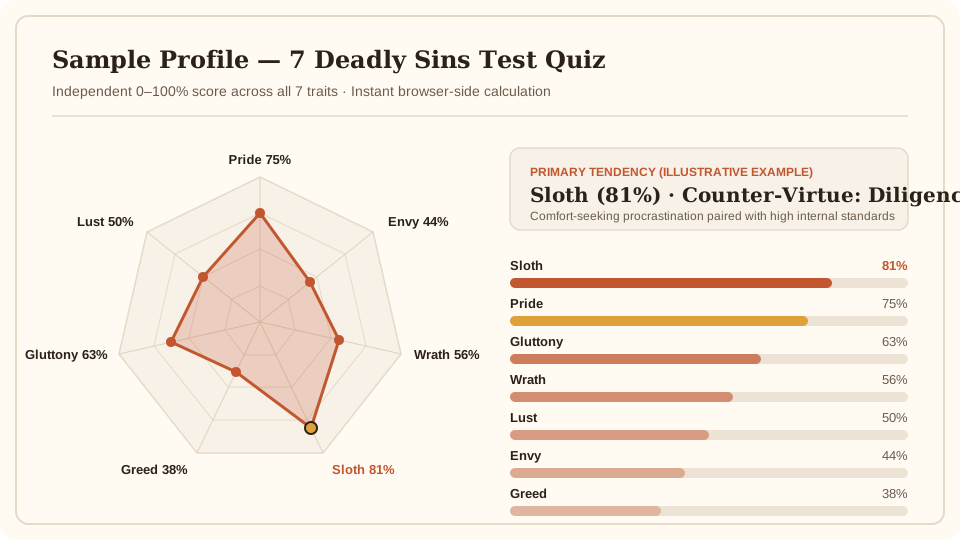
(trait points ÷ 12) × 100, rounded to the nearest whole percent. - No Forced Single Winner: Because every axis is independent, your seven percentages do not need to total 100%. You can easily score 75% in both Sloth and Pride, or score under 40% across all seven traits if few statements fit your habits.
The Seven Deadly Sins and Their Counter-Virtues Explained
Understanding what sits underneath each score makes your chart far more useful than a single label. The table below summarizes all seven traits measured in the quiz alongside their traditional balancing virtues.
| Sin Trait | Modern Behavioral Pattern | Classical Counter-Virtue | Constructive Reframe |
|---|---|---|---|
| Pride | Defensiveness around mistakes, reluctance to ask for help, superiority | Humility | High personal standards paired with openness to feedback |
| Envy | Painful social comparison, resentment toward peers' effortless wins | Gratitude & Kindness | Using admiration as a clear signal of what you want to build |
| Wrath | Short fuse, sharp frustration over friction, replaying grudges | Patience | Channeling fierce energy for fairness into calm boundaries |
| Sloth | Chronic procrastination, comfort drift, fading follow-through | Diligence | Protecting energy while building tiny, repeatable daily starts |
| Greed | Scarcity mindset, hoarding leverage or credit, never feeling "enough" | Generosity | Smart resourcefulness balanced by clear limits and sharing |
| Gluttony | Overindulgence in snacks, shows, shopping, or scrolling past satisfaction | Temperance | Savoring pleasure intentionally with a chosen stopping point |
| Lust | Chasing intense passion, novelty, or thrills over steady priorities | Self-Mastery | Directing vibrant emotional energy into meaningful commitments |
Pride — High Standards Turned Defensive
In everyday life, Pride rarely looks like cartoon bragging. More often it shows up as perfectionism, hyper-independence, and a quiet flinch whenever someone corrects you. When Pride scores highest on your 7 Deadly Sins test quiz, practicing Humility simply means separating your self-worth from being right on the first try.
Envy — Comparison Stealing Your Own Momentum
Envy flares when you measure your behind-the-scenes effort against somebody else's polished highlight reel. A higher Envy percentage does not mean you wish others harm; usually it signals unvoiced ambition. Pairing it with Gratitude turns bitter comparison into curiosity about what habits actually matter to you.
Wrath — Fast Heat When Lines Get Crossed
Wrath reflects how quickly irritation builds when people move slowly, act carelessly, or cross a boundary. Left unchecked, it escalates minor annoyances into regretful exchanges. Cultivating Patience introduces a brief pause between the spark and your response so your point lands cleanly.
Sloth — Comfort Seeking and Inertia
Modern Sloth is often disguised as busyness or mental exhaustion. It shows up when important projects get delayed until panic takes over, or free hours evaporate in passive scrolling. Diligence is not about grinding nonstop—it is about shrinking the first step until momentum feels light.
Greed — Moving the Goalpost of "Enough"
Greed centers on scarcity thinking: feeling uneasy until you hold more money, status, security, or advantage than before. While foresight and ambition are valuable, Generosity reminds you to define what "enough" actually looks like so achievement feels satisfying rather than endless.
Gluttony — Trouble Stopping While Something Feels Good
Gluttony extends far beyond food. In modern routines it often appears as binge-watching past bedtime, stress shopping, or endless feeds used to numb boredom. Temperance restores enjoyment by helping you savor a defined portion instead of consuming on autopilot.
Lust — Appetite for Intensity and Novelty
Psychologically, Lust measures how strongly you are pulled toward sensory spark, romantic chemistry, and thrilling breaks from routine. That same drive fuels passion and vitality; Self-Mastery keeps intensity aligned with the commitments you care about most.
How to Read Your Results Honestly
Treat your 7 Deadly Sins test quiz chart as a snapshot of current habits rather than a permanent verdict on your character. Notice both your highest bar and your lowest bar—often the contrast between them explains a lot about how you handle stress. For instance, high Pride combined with high Sloth is a classic perfectionist procrastination loop: delaying a project because you want the result to be flawless.
This quiz is created solely for self-reflection, entertainment, and thoughtful conversation—not for clinical, medical, or psychological diagnosis. Want to explore more free assessments as our library grows? Head back to the Traitself homepage or read more on our About page.