
Quick Facts at a Glance
Here is what this 7 Deadly Sins test measures and how your results are produced locally:
| Feature | Details on Traitself |
|---|---|
| Questions & Time | 21 modern everyday statements (3 per axis) · ~3 minutes |
| Dimensions Scored | 7 independent axes: Pride, Envy, Wrath, Sloth, Greed, Gluttony, and Lust |
| Scoring Model | 5-point Likert scale (0–4) · Independent 0%–100% score per axis |
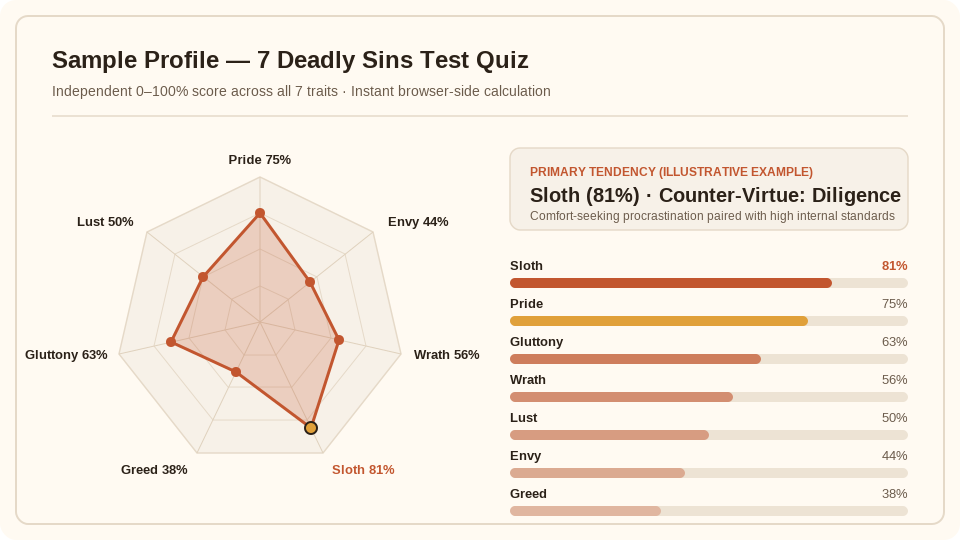
| Visual & Share Output | Live 7-axis SVG radar chart, ranked bars, local 1080×620 PNG card download, plain-text summary, and optional friend comparison link |
| Cost & Full Results | 100% free full results — all 7 scores, radar chart, PNG card, friend comparison, and all 7 profile guides with no paid report unlock, no account, and no email gate |
| Platform & Mobile | Browser web app — no app download; one-question touch-friendly cards built for iPhone (Safari), Android (Chrome), and desktop with no disruptive full-screen pop-ups |
| Daily Limits & Retakes | No daily limit or cooldown — take and retake as many times as you want for free |
| Privacy & Answer Storage | Answers stay in active browser memory, clear on tab close or refresh, and never upload to a server (Privacy Policy); optional friend-compare links (?you=...) encode only your 7 percentages locally if you choose to share |
| Scope | Personal self-reflection and entertainment (not a clinical or medical diagnosis) |
What Are the Seven Deadly Sins?
The seven deadly sins—Pride, Envy, Wrath, Sloth, Greed, Gluttony, and Lust—are a classical taxonomy of seven recurring human impulses that derail balance when left unchecked. Originally catalogued as "capital vices" because each habit sparks secondary behaviors, they now serve as a widely recognized shorthand for everyday personality friction such as perfectionism, social comparison, impatience, and procrastination.
Historically, early ethical thinkers classified these seven patterns as root tendencies rather than isolated actions. In the Catechism of the Catholic Church (§1866), they are listed as capital vices following Gregory the Great and John Cassian, while Thomas Aquinas analyzed why each functions as a driving "head" of subordinate habits in his Summa Theologiae on the seven capital vices.
In parallel, classical ethical writers paired each vice with a stabilizing opposite—a remedial habit rooted in the broader tradition of virtue ethics. Rather than framing anyone as permanently flawed, pairing a strong impulse with a counter-virtue highlights a practical daily counterweight. For a complete side-by-side breakdown of modern meanings, visit our Seven Deadly Sins Meaning guide.
Which Deadly Sin Are You?
Finding out which deadly sin fits you best depends on which everyday friction loop shows up most consistently under stress: refusing help points toward Pride, restless comparison points toward Envy, quick heat points toward Wrath, deadline delay points toward Sloth, moving the goalpost of "enough" points toward Greed, trouble stopping points toward Gluttony, and chasing intensity points toward Lust.
Because real people rarely fit one narrow box, this assessment scores all seven axes separately rather than forcing a single winner-take-all stereotype. Once you finish the 21 statements above, your top percentage links directly to its full personality breakdown—or you can explore any of the seven dedicated result guides directly below:
| Trait & Result Guide | Modern Behavioral Pattern | Counter-Virtue | Constructive Reframe |
|---|---|---|---|
| Pride | Defensiveness around mistakes, reluctance to ask for help, perfectionism | Humility | High personal standards paired with openness to feedback |
| Envy | Painful social comparison, resentment toward peers' effortless wins | Gratitude & Kindness | Using admiration as a clear signal of what you want to build |
| Wrath | Short fuse, sharp frustration over friction, replaying grudges | Patience | Channeling fierce energy for fairness into calm boundaries |
| Sloth | Chronic procrastination, comfort drift, fading follow-through | Diligence | Protecting energy while building tiny, repeatable daily starts |
| Greed | Scarcity mindset, hoarding leverage or credit, never feeling "enough" | Generosity | Smart resourcefulness balanced by clear limits and sharing |
| Gluttony | Overindulgence in snacks, shows, shopping, or scrolling past satisfaction | Temperance | Savoring pleasure intentionally with a chosen stopping point |
| Lust | Chasing intense passion, novelty, or thrills over steady priorities | Self-Mastery | Directing vibrant emotional energy into meaningful commitments |
How Scoring Works
Here is the exact math running inside your browser:
- 21 Interleaved Statements: Each of the seven axes is measured by three concrete everyday scenarios arranged in mixed order so you respond instinctively without second-guessing categories.
- 5-Point Agreement Scale: Every choice maps to a fixed integer: Strongly Disagree =
0, Disagree =1, Neutral =2, Agree =3, and Strongly Agree =4. - Independent Percentage Formula: Each axis has a maximum raw score of 12 points (
3 items × 4 points). Your percentage is calculated independently as(axis points ÷ 12) × 100, rounded to the nearest whole percent. For example, scoring 9 out of 12 points on Pride gives 75%, while scoring 6 out of 12 on Envy gives 50%. - Honest Tie Handling: Because every axis is independent, your seven percentages do not need to total 100%. When two or more axes tie at the top, both appear together as co-dominant tendencies with links to each matching guide.
What Makes This Assessment Useful
Five design choices separate a thoughtful self-reflection tool from a throwaway novelty quiz:
- Independent percentages over forced labels: Combinations like high Pride paired with high Sloth (perfectionist procrastination) only become visible when every axis stands on its own 0–100% scale.
- Transparent scoring math: You can inspect the exact formula and review all 21 statements in the expandable list below.
- Zero email gates, paywalls, or paid report unlocks: All 7 percentages, your live radar chart, downloadable PNG card, friend comparison link, and all seven deep-dive profile guides unlock immediately for free after statement 21.
- Transparent browser-side privacy: Individual responses stay in active browser memory, clear automatically when you close or refresh the tab, and never touch a server (see our Privacy Policy for aggregate analytics and optional ad cookies); optional friend-compare links encode only your seven rounded percentages inside the URL so you stay in control of who sees them.
- Clean mobile experience & unlimited retakes: Each statement renders one card at a time with large tap targets on iPhone Safari and Android Chrome, requiring no app download, no intrusive pop-ups, and carrying no daily retake limit.
How to Read Your Profile Honestly
Treat your radar chart as a snapshot of current habits rather than a fixed label on your character. Notice both your highest bar and your lowest bar—often the gap between them explains how you react under pressure. After reviewing your top result page, you can also explore our Personality Test Directory, take the Big Five Personality Test, try the Dere Test, or check the Handwriting Personality Test.