Quick Facts at a Glance
Here is what this 7 Heavenly Virtues test measures and how your results are computed locally in your browser:
| Feature | Details on Traitself |
|---|---|
| Questions & Time | 21 modern everyday statements (3 per virtue) · ~3 minutes |
| Dimensions Scored | 7 independent axes: Humility, Kindness, Patience, Diligence, Charity, Temperance, and Chastity |
| Scoring Model | 5-point Likert scale (0–4) · Independent 0%–100% score per virtue |
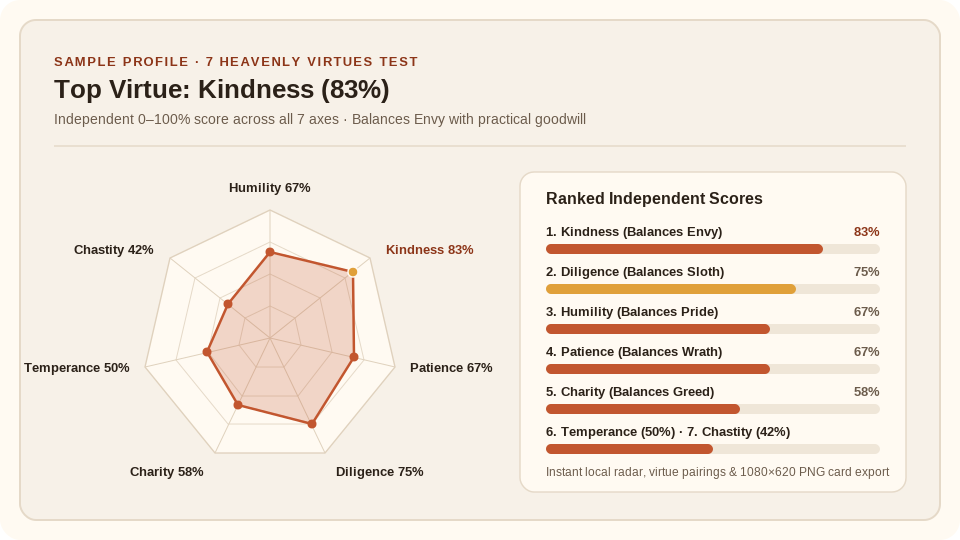
| Visual & Share Output | Live 7-axis SVG radar chart, ranked bars, local 1080×620 PNG card download, plain-text copy, and optional ?you= friend comparison overlay |
| Opposing-Sin Pairing | Each virtue card links to its matching tendency on our Seven Deadly Sins guide |
| Mobile & Device Support | Responsive web app for iPhone (Safari), Android (Chrome), tablets, and desktop — large single-tap buttons, zero app download |
| Cost & Access | 100% free full results — zero email gates, zero account sign-ups, and zero paywalls |
| Privacy & Retakes | Answers stay strictly in browser tab memory, clear on close/refresh, and are never uploaded, stored, or sold (Privacy Policy); unlimited free retakes |
What Are the Seven Heavenly Virtues?
The seven heavenly virtues—Humility, Kindness, Patience, Diligence, Charity, Temperance, and Chastity—are the classical seven contrary virtues defined in moral philosophy as steady everyday habits that directly counteract the seven deadly sins. Rather than distant perfection, each virtue describes a practical discipline you practice under pressure: admitting an error openly, celebrating a friend's success without comparison, keeping your tone calm in delays, finishing unglamorous work, sharing without keeping score, knowing when enough feels good, and honoring boundaries.
In classical literature, the fourth-century Christian poet Prudentius popularized the pairing of virtues against vices in his allegorical poem Psychomachia, and later thinkers grouped the seven remedial habits cleanly opposite the capital vices explored in our Seven Deadly Sins Meaning guide. Broader philosophical foundations of habit-based character sit inside classical virtue ethics, while Thomas Aquinas analyzed the counterpart vice taxonomy in his Summa Theologiae.
Notice how seven heavenly virtues differ from the four cardinal virtues (Prudence, Justice, Fortitude, Temperance) plus three theological virtues (Faith, Hope, Charity): when people search for a "7 Heavenly Virtues test," most expect the seven contrary virtues paired directly one-for-one against Pride, Envy, Wrath, Sloth, Greed, Gluttony, and Lust, so every score reveals both what anchors you and which everyday friction you naturally resist.
Which Heavenly Virtue Are You?
Your highest virtue percentage highlights the instinct you rely on most naturally when daily life tests your patience, pride, or focus. Because every axis runs on an independent 0–100% scale, you can score strongly across several virtues at once or discover a specific habit you want to strengthen next.
| Heavenly Virtue | Everyday Behavioral Signature | Opposing Shadow Trait | Grounded Strength in Practice |
|---|---|---|---|
| Humility | Receptive to honest feedback, comfortable saying "I don't know yet," credits behind-the-scenes peers | Pride | Calm confidence without needing to win every room |
| Kindness | Celebrates others' wins freely, notices quiet outsiders, sends sincere encouragement | Envy | Warmth that turns comparison into goodwill |
| Patience | Keeps composure during delays, pauses in conflict, treats service workers courteously | Wrath | Steady emotional pacing under everyday friction |
| Diligence | Works steadily on unglamorous ordinary days, finishes the final 10 percent cleanly | Sloth | Reliable follow-through long after novelty fades |
| Charity | Shares templates and shortcuts, helps freely without mental scorecards | Greed | Generous abundance that lifts peers without keeping tabs |
| Temperance | Stops enjoying snacks, shows, or scrolling cleanly once satisfied | Gluttony | Intentional enjoyment that recharges instead of draining |
| Chastity | Honors clear personal boundaries and faithful depth over fleeting chemistry | Lust | Self-mastery and respectful steadiness in close bonds |
7 Heavenly Virtues vs. 7 Deadly Sins
Taking both seven-axis quizzes side by side gives the clearest full picture of your habits. While our 7 Deadly Sins Test surfaces the stress loops you fall into when tired, rushed, or defensive, this 7 Heavenly Virtues Test measures the intentional practices you actively show up with on good and ordinary days alike.
- Pride vs. Humility: Defensiveness and status protection give way to curiosity and shared credit.
- Envy vs. Kindness: Keeping score against peers softens into genuine happiness for their momentum.
- Wrath vs. Patience: Instant heat in delays slows into measured response and courteous boundaries.
- Sloth vs. Diligence: Postponing hard starts shifts into consistent progress on ordinary days.
- Greed vs. Charity: Hoarding margin or leverage opens into open-handed contribution.
- Gluttony vs. Temperance: Automatic overconsumption yields to deliberate savoring and stopping points.
- Lust vs. Chastity (Self-Mastery): Chasing fleeting thrills yields to integrated respect and faithful focus.
How Scoring Works
Every calculation runs transparently inside your browser using fixed, unweighted integers:
- 21 Balanced Statements: Each of the seven virtues has three concrete, everyday behavioral statements interleaved across the quiz.
- 5-Point Agreement Scale: Each option maps directly to a point value: Strongly Disagree =
0, Disagree =1, Neutral =2, Agree =3, and Strongly Agree =4. - Independent Percentage Formula: Each virtue spans
0to12raw points (3 items × 4 points). Your axis score is(raw points ÷ 12) × 100, rounded to the nearest integer percent. Scoring9out of12on Humility yields75%; scoring6out of12on Diligence yields50%. - Co-Leading Virtue Support: Your seven scores never compete inside a forced 100% pie. If two or more virtues tie at your highest percentage, all tied virtues appear together alongside your lowest-scoring growth area.
- Scale Percentage, Not a Population Percentile: A score such as
75%reflects9out of12points on our 5-point agreement scale—not a ranking against other test-takers. Because each virtue uses3items (12max points), shifting one statement by a single step changes that virtue by1/12(about8.3percentage points). - Independent Self-Reflection (Not a Clinical Diagnosis): Your virtue percentages are measured independently from our 7 Deadly Sins Test—not calculated as
100minus a sin score or subtracted into a net goodness total. Like other online virtue quizzes, this assessment has no clinical population norms or formal psychometric validation study and is built strictly for honest personal reflection.
How to Read Your Virtue Profile Honestly
Look at both ends of your ranked bar list rather than stopping at your #1 score. Your leading virtue reveals where your daily habits feel almost effortless, while your lowest score points directly to the one small practice that can change how stressful weeks feel. After saving your radar card or comparing with a friend, you can contrast your shadow patterns in the 7 Deadly Sins Test, measure scientific personality factors with the Big Five Personality Test, explore anime affection styles in the Dere Test, or browse all guides in the Personality Test Directory.