Quick Facts at a Glance
Here is what this Dere test measures and how your results are generated locally:
| Feature | Details on Traitself |
|---|---|
| Questions & Time | 18 everyday romance & friendship scenarios (3 per type) · ~2 minutes |
| Archetypes Covered | 6 classic axes: Tsundere, Yandere, Kuudere, Dandere, Deredere, and Himedere |
| Scoring Model | 5-point Likert scale (0–4) · Independent 0%–100% score per type (no forced single label) |
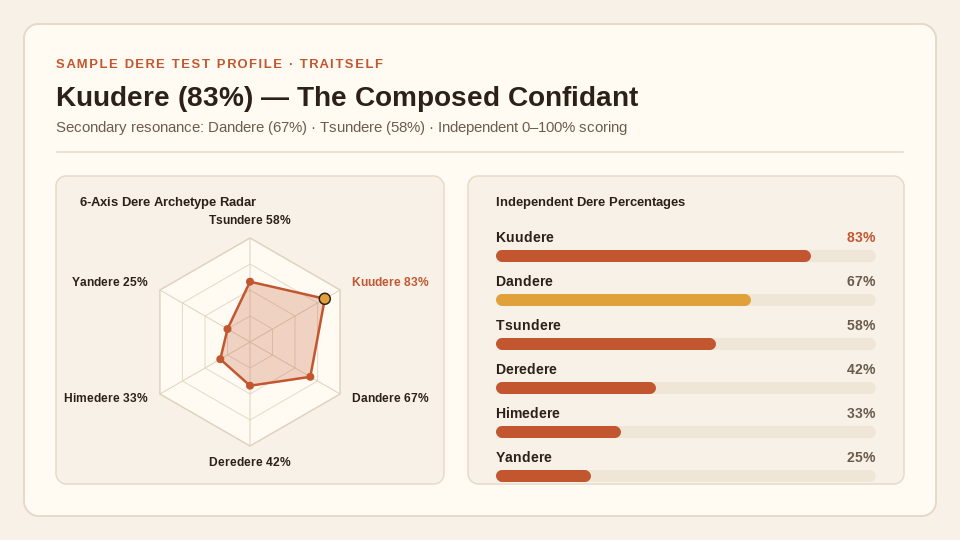
| Visual & Share Output | Live 6-axis hexagon SVG radar chart, ranked bars, local 1080×620 PNG card download, and plain-text summary |
| Cost & Full Results | 100% free full results — all 6 percentages (Tsundere, Yandere, Kuudere, Dandere, Deredere, Himedere), radar chart, PNG card, and all 6 guides with no paid report unlock, no account, and no email gate |
| Platform & Mobile | Browser web app — no app download; one-scenario touch-friendly cards built for iPhone (Safari), Android (Chrome), and desktop with no disruptive full-screen pop-ups |
| Daily Limits & Retakes | No daily limit or cooldown — take and retake as many times as you want for free |
| Privacy & Answer Storage | Answers stay in active browser memory, clear on tab close or refresh, and never upload to a server (Privacy Policy) |
| Scope | Fun, self-reflection, and ACG fandom comparison (not a clinical psychological diagnosis) |
What Are Dere Types in Anime and Everyday Life?
In Japanese pop culture, -dere archetypes trace back to manga, light novels, and visual novels documented in the broader glossary of anime and manga terminology. The word stems from deredere (デレデレ), an onomatopoeia for acting lovestruck or melting with affection. Early hits popularized characters like the hot-and-cold Tsundere and the intensely devoted Yandere, and fandom communities gradually expanded the vocabulary to cover cool, shy, openly sunny, and regal affection styles.
Instead of asking absurd cartoon questions, this 18-question quiz translates those six classic patterns into recognizable modern moments: how you react to an unexpected compliment, whether you rehearse messages before hitting send, how you respond when someone close pulls away, and whether you express care through cheerful words or quiet dependability.
Which Dere Type Are You? Explore All 6 Core Guides
Every archetype scored in this assessment represents a distinct contrast between outer poise and inner affection. Finish the quiz above to see your top match immediately—or open any of the six dedicated guides below, or browse the complete Dere Types hub:
| Dere Type Guide | Japanese Root | Outer Persona | Inner / Hidden Side | Signature Affection Style |
|---|---|---|---|---|
| Tsundere | Tsun-tsun (prickly) + dere | Guarded, teasing, easily flustered | Fiercely loyal, soft-hearted, caring | Quiet favors disguised as "no big deal" |
| Kuudere | Kūru (cool) + dere | Calm, deadpan, composed | Deeply devoted, observant, steady | Practical help and dependable presence |
| Dandere | Danmari (silent) + dere | Quiet, shy, reserved in crowds | Warm, sweet, surprisingly talkative | Attentive one-on-one listening and care |
| Deredere | Dere-dere (lovestruck) | Sunny, energetic, open-hearted | Consistently warm and sincere | Direct compliments, enthusiasm, encouragement |
| Himedere | Hime (princess) + dere | Poised, high-standard, playful pride | Generous and fiercely protective | Treasuring thoughtful gestures and exclusivity |
| Yandere | Yanderu (consumed) + dere | Sweet, attentive, deeply invested | All-or-nothing intensity and vigilance | Unwavering focus, high loyalty, strong protectiveness |
(Looking for niche fandom subtypes like Bakadere, Darudere, Oujidere, Kamidere, or Mayadere? Our Dere Types Explained guide maps 18 classic and niche dere types side by side with anime character examples.)
How Scoring Works in This Quiz
Here is the exact scoring math running locally in your browser:
- 18 Interleaved Scenarios: Each of the six archetypes is measured by three concrete statements arranged in mixed order so you answer naturally without guessing categories. You can review every prompt verbatim in the expandable list below.
- 5-Point Agreement Scale: Every choice maps to a fixed integer: Strongly Disagree =
0, Disagree =1, Neutral =2, Agree =3, and Strongly Agree =4. - Independent Percentage Formula: Each archetype has a maximum raw score of 12 points (
3 scenarios × 4 points). Your score for every type is computed independently as(archetype points ÷ 12) × 100, rounded to the nearest whole percent. For example, scoring 9 out of 12 points on Kuudere gives 75%, while scoring 6 out of 12 on Dandere gives 50%. - Honest Hybrid Handling: Because every axis is scored separately, your six percentages do not need to sum to 100%. When two or more types tie for first place, the results screen highlights your hybrid profile and links directly to each matching breakdown page.
What Makes This Dere Test Different
Five design choices set this browser quiz apart from bloated pop-up quizzes and paywalled personality tests:
- Independent percentages across all 6 classic types: Unlike BuzzFeed- or Quotev-style quizzes that assign one rigid label, every archetype (Tsundere, Yandere, Kuudere, Dandere, Deredere, Himedere) gets its own 0–100% bar and hexagon radar axis so hybrids show up clearly.
- Fast 18-scenario flow (~2 minutes): Shorter and cleaner than 35–50 question quizzes while keeping three balanced scenarios per type, all visible in the expandable question list below.
- 100% free full breakdown—no paid report paywall or email gate: Unlike sites that tease a top label and charge for a full breakdown, all six percentages, the radar chart, local 1080×620 PNG card, and all six guides unlock immediately for free.
- Browser-memory privacy by default: Individual answers stay only in active browser memory inside your tab, clear on close or refresh, and never touch a server (see our Privacy Policy for basic aggregate analytics and optional ad cookies).
- Clean mobile experience & unlimited retakes: Built with 44px+ full-width tap buttons for iPhone Safari and Android Chrome, no app download, no intrusive full-screen pop-ups, and no daily retake limit.
How to Read Mixed or Dual Results
Most people are hybrids rather than a single anime trope. You might score Kuudere + Dandere if you stay calm and quiet in large groups while saving your warmest conversation for one trusted person, or Tsundere + Himedere if you pair teasing banter with high personal standards. Look at both your top two bars and your lowest bar—the contrast between how openly you show warmth and how guarded you feel under vulnerability tells the clearest story.
Want to compare all 18 core and niche archetypes side by side? Visit the Dere Types guide, explore our Personality Test Directory, or return to the Traitself homepage.